
Field Essay
Cancelled AI projects signal discipline, not a failing technology
Three enterprise AI numbers read as evidence the technology is stalling. Read them again and they show buyers finally pricing AI on proof of value. The gap worth worrying about sits in the platform bets nobody gates.
· 4 min read · Kumaresh Bhuyan
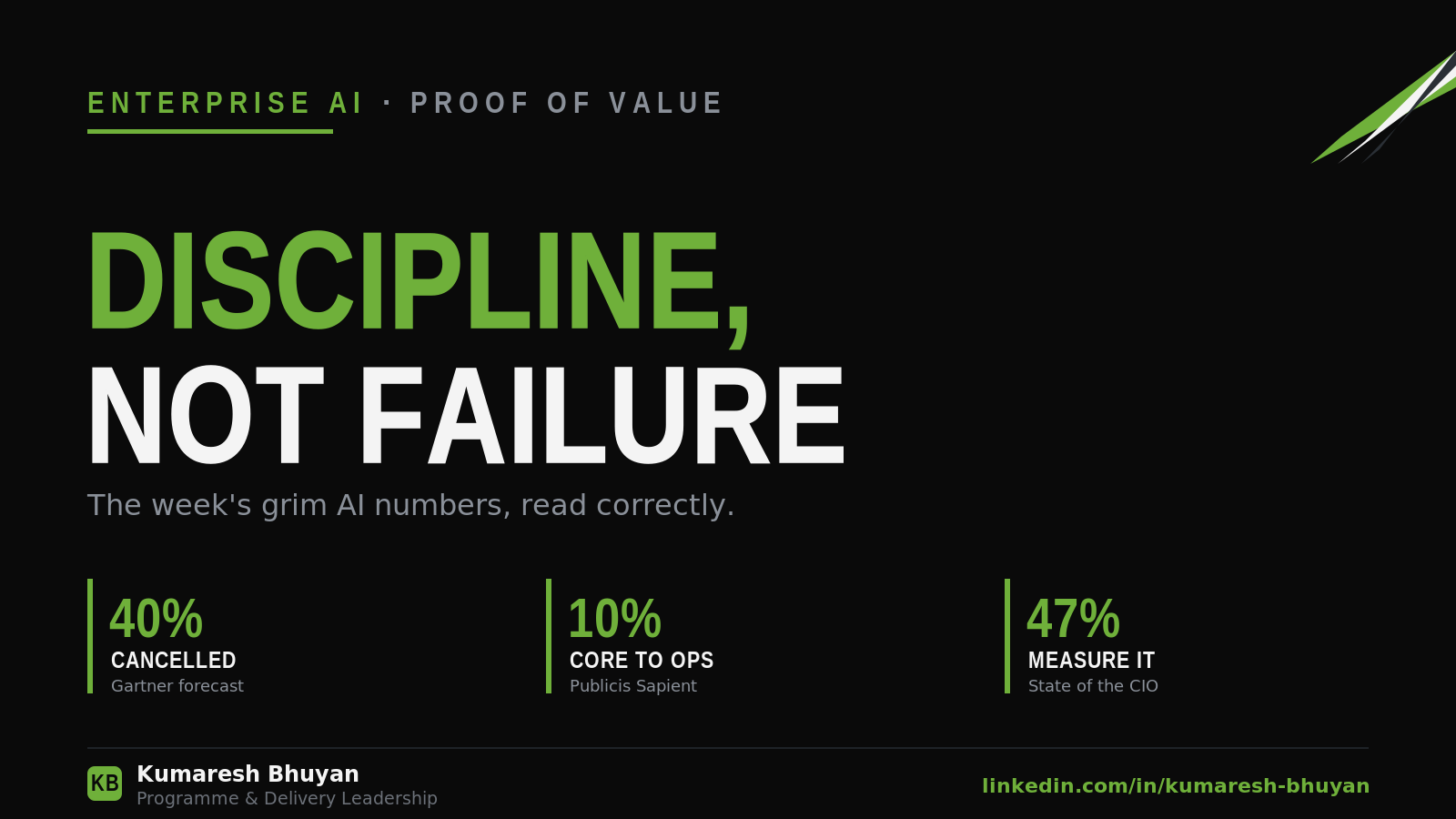
Three enterprise AI numbers were in front of leaders this week and each one was read as evidence that the technology is stalling. That reading has it backwards. The cancelled projects and the low adoption scores are not AI failing. They are enterprises finally pricing AI on proof of value, and that shift toward measurement is the healthiest signal the market has produced all year. The gap worth worrying about sits somewhere else, in the platform and architecture bets those same buyers still make on faith.
The week told as bad news
Gartner's standing forecast is that more than 40 percent of agentic AI projects will be cancelled by the end of 2027. A 2026 Publicis Sapient survey put regular enterprise AI use at 73 percent while only 10 percent of firms said it was core to how the business runs. A 2026 State of the CIO survey found that just 47 percent of enterprises have set formal metrics for their AI work, with another third still planning to. Strung together, these numbers get told as one story of disappointment. The story becomes pilots that went nowhere, spending without a return, and a widening gap between the hype and the operating reality.
What the numbers actually measure
Read the Gartner reasoning rather than the headline. It attributes the cancellations to escalating costs, unclear business value, and inadequate risk controls. Be honest about what that means, because not all of the 40 percent is virtue. A share of those projects were hype-driven from the start and should never have been funded, and unwinding them is waste, not discipline. The claim worth defending is narrower. A cancellation counts as governance working only when something was being measured and the project failed a real value gate, not when there was never a gate at all. That distinction is the whole point. In 2023 and 2024 almost nothing got cancelled, because almost nothing was being measured against a number. The useful reading of the week is that far more firms are now applying a gate, and a market where projects fail one is more mature than one where every experiment survives on optimism. The 10 percent core-to-operations figure says the same thing from the other side. Most firms have stopped confusing access to a tool with genuine reliance on it, and only the second one counts.
Where the discipline stops
Then set those numbers against the fourth story of the week. Etched, which builds chips wired specifically for the transformer architecture, is reportedly in talks to raise at a valuation near 20 billion dollars, roughly quadruple its previous mark. The bet is that transformers stay dominant long enough for single-architecture silicon to repay its efficiency advantage over general-purpose GPUs. Backing a bet like that is what risk capital exists to do, so this is not a complaint about how Etched raises money. The asymmetry worth noticing sits on the buyer's side. The same enterprises now demanding a defined value from every internal pilot will still commit to an architecture like transformer-only silicon on the promise of efficiency, without applying the gate they have learned to use everywhere else. Efficiency that depends on today's architecture holding is a loan, not a saving, until the assumption survives long enough to repay it. The discipline has reached the pilot you run and not yet the platform you buy into.
What this changes for a leader
So the operator lesson runs opposite to the mood in the room. If your own AI programme is cancelling pilots this year, that is not something to apologise for in a budget review. It is evidence your review process works, provided each cancellation came with a reason that finance recognises. The failure to guard against is the quieter one, the platform bet sitting inside your own stack, where you commit to a tool, a vendor, or an architecture on the promise of efficiency without a defined value gate or a named owner. I run an internal reskilling pipeline on a simple rule. Nothing goes live until the team that owns the workflow can explain what it does and correct it when it is wrong. That rule is cheap to apply to a pilot, and it is exactly the check the biggest architecture bets tend to skip.
The synthesis across the week is that discipline is arriving in enterprise AI, just unevenly. It has reached the pilots you start and kill. It has not yet reached the platform and architecture bets you commit to. Judge your own programme by whether every live initiative has a number it must move and a person who answers for it, not by how many pilots you happen to be running. Which of your current AI commitments would survive being cancelled on the same evidence you would demand before approving a new one?
The Execution Edge
A monthly deep dive on enterprise AI and turning strategy into execution, written from inside the programme office rather than above it.