
Field Essay
The agent list you believe versus the one you can test
Most leaders say their organisation has a complete list of its AI agents, and in one large survey fewer than half run the discovery tooling that could check it. A list people believe is complete is a different thing from a list someone has tested.
· 4 min read · Kumaresh Bhuyan
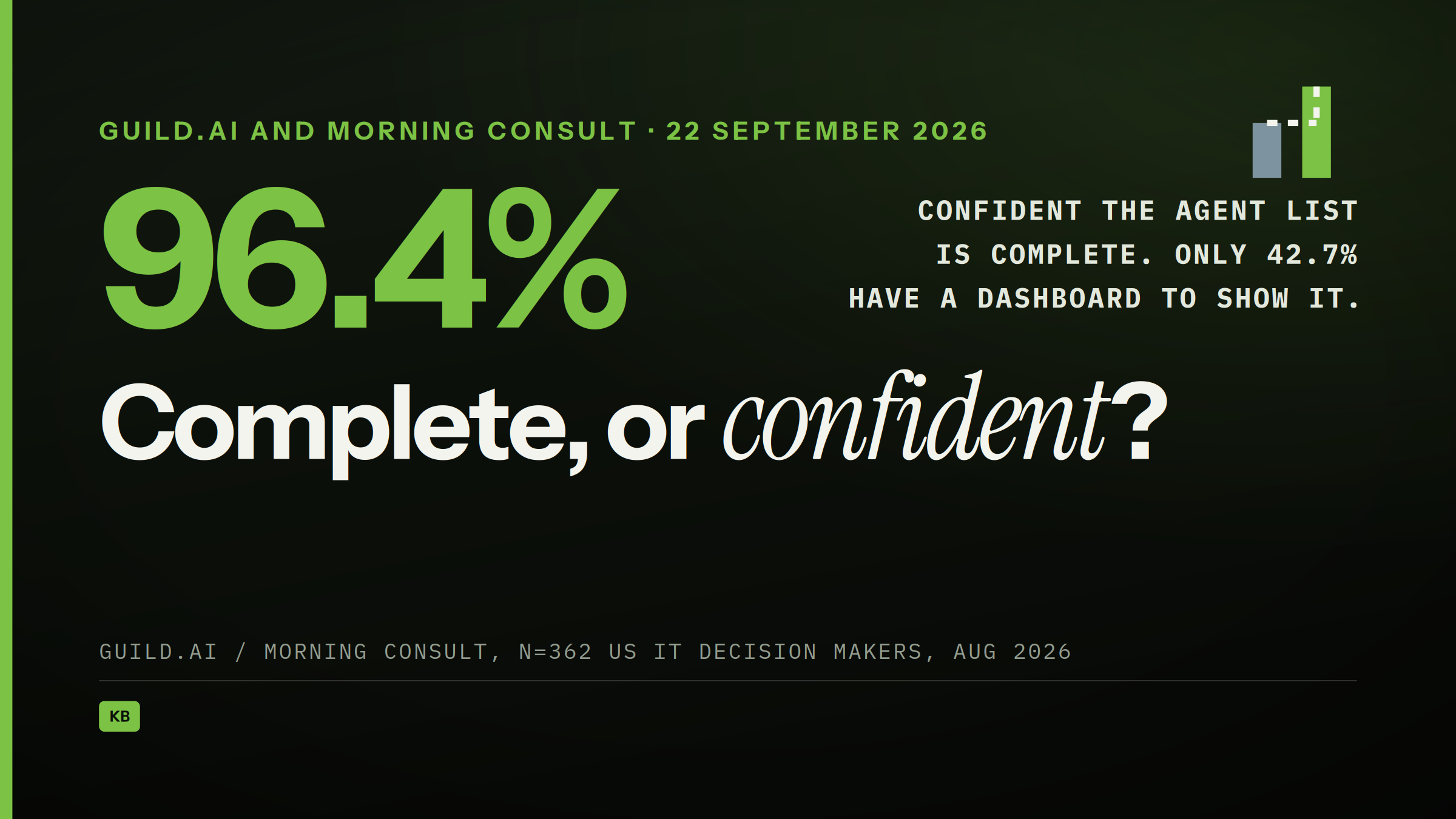
Most leaders say their organisation has a complete list of its AI agents, and in one large survey fewer than half run the discovery tooling that could check it. A list people believe is complete is a different thing from a list someone has tested.
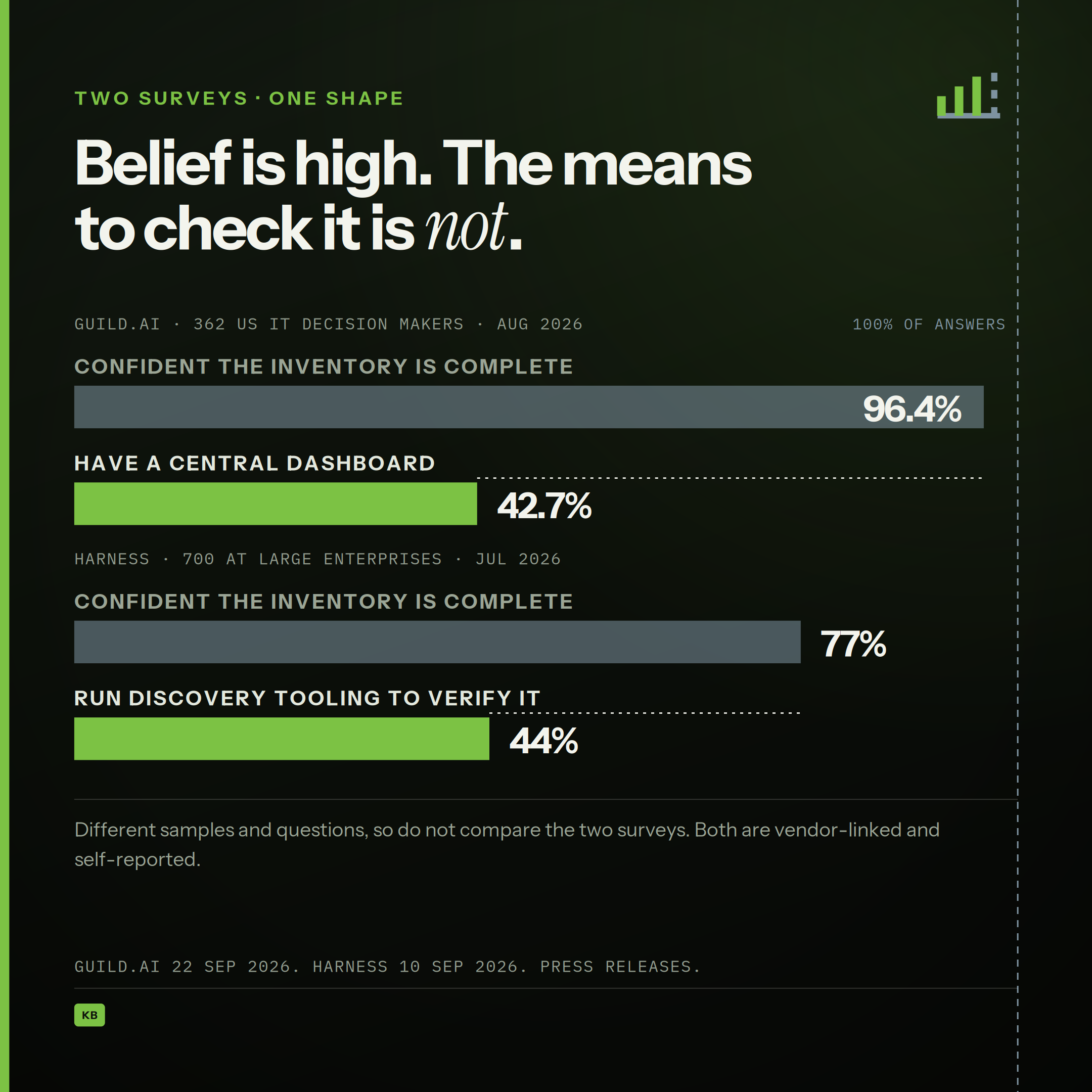
In September two companies published surveys that asked technology leaders the same thing in different words. Guild.ai, working with Morning Consult, asked 362 IT decision makers in the US and found 96.4% confident their agent inventory is complete and accurate. Harness, working with Sapio Research, asked 700 people at large enterprises across five countries and found 77% confident they hold a complete inventory of the agents and models running in production.
The second number in each survey is the one worth reading. In Guild's, only 42.7% have a central dashboard and 39.8% keep logs of what their agents do. In Harness's, only 44% run discovery tooling that could check the list.
An earlier survey run by the Cloud Security Alliance and commissioned by Token Security found 82% reporting unknown agents running in their infrastructure.
I read the vendor's own methodology panel next to the press release, and the useful detail is small. Guild's report limits its scope to agents that are internally built and actively managed. That suggests the agents nobody told IT about sit outside the question, so a leader can be right about the list and still be wrong about the estate.
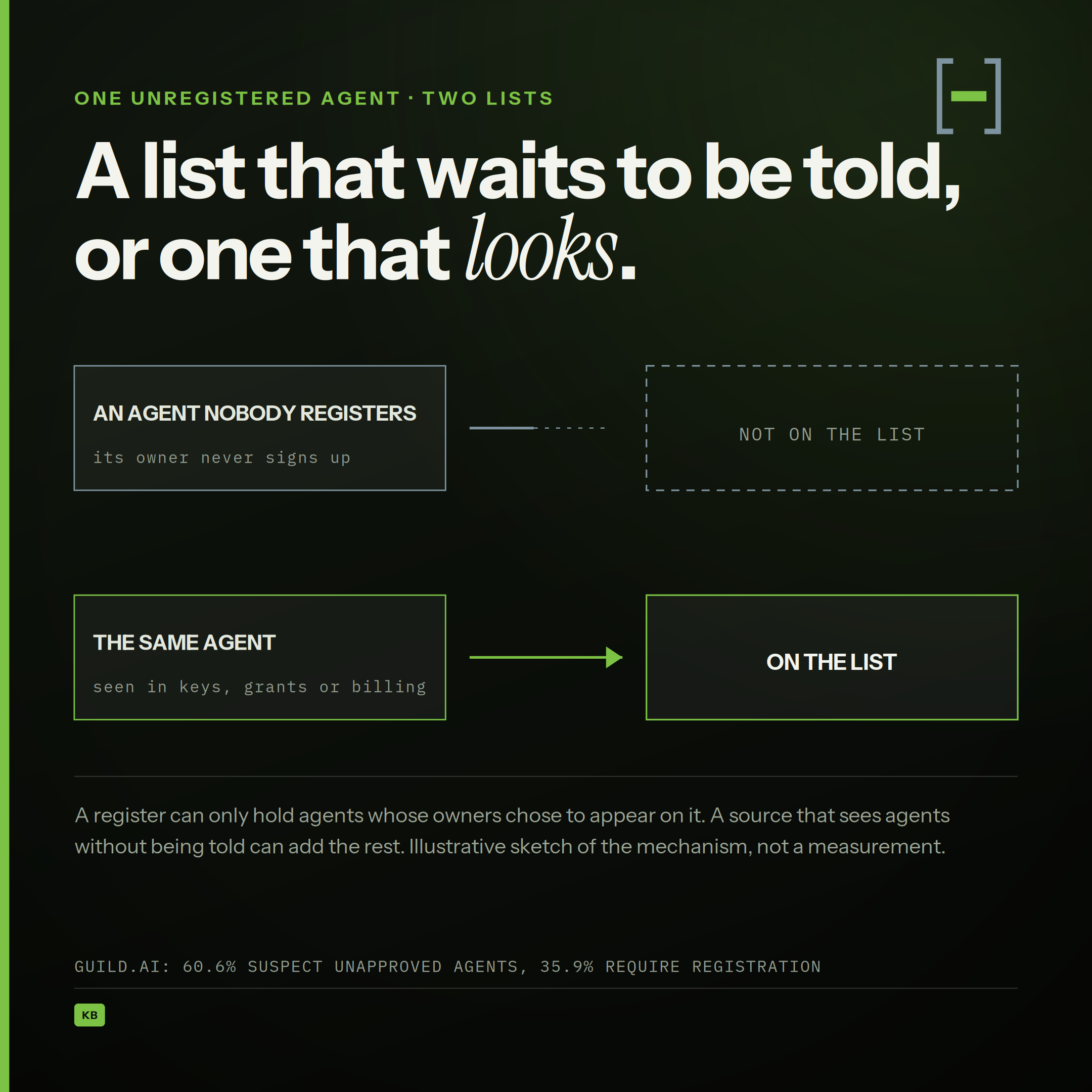
That gives a distinction I would carry into a meeting. A believed inventory is built by asking people to register what they run. A tested inventory is checked against something that sees agents without being told.
The believed list can only contain agents whose owners chose to appear on it. In Guild's survey only 35.9% require registration before deployment, while 60.6% say employees are likely deploying agents without formal approval. A register under those conditions is a record of the willing.
None of this is new. The CIS Critical Security Controls, a long-standing checklist for securing computer estates, tell organisations to keep their asset inventory current with an active discovery tool that runs daily or more often.
Shadow IT taught the same lesson about unapproved software, and agents are the same problem on a faster curve.
There are three fair objections. Guild and Harness both sell into this problem, and a vendor has a reason to find a gap. Confidence is an opinion, so these numbers do not prove that any particular list is wrong, and Guild's scope line means the gap may be smaller for agents people manage on purpose.
I concede all of that, and what survives is narrow. Neither survey shows that your list is incomplete. Harness's figures do suggest that more than half of the large enterprises it surveyed run no discovery tooling that could tell them.
Here is what I would do. Pick one source that sees agents without being told, such as the API keys in your model providers' admin consoles, the third party app grants in your identity provider (the system that handles staff logins), or the model usage lines on the cloud bill.
Compare it with the list you hold and write down how many agents appear in one and not the other.
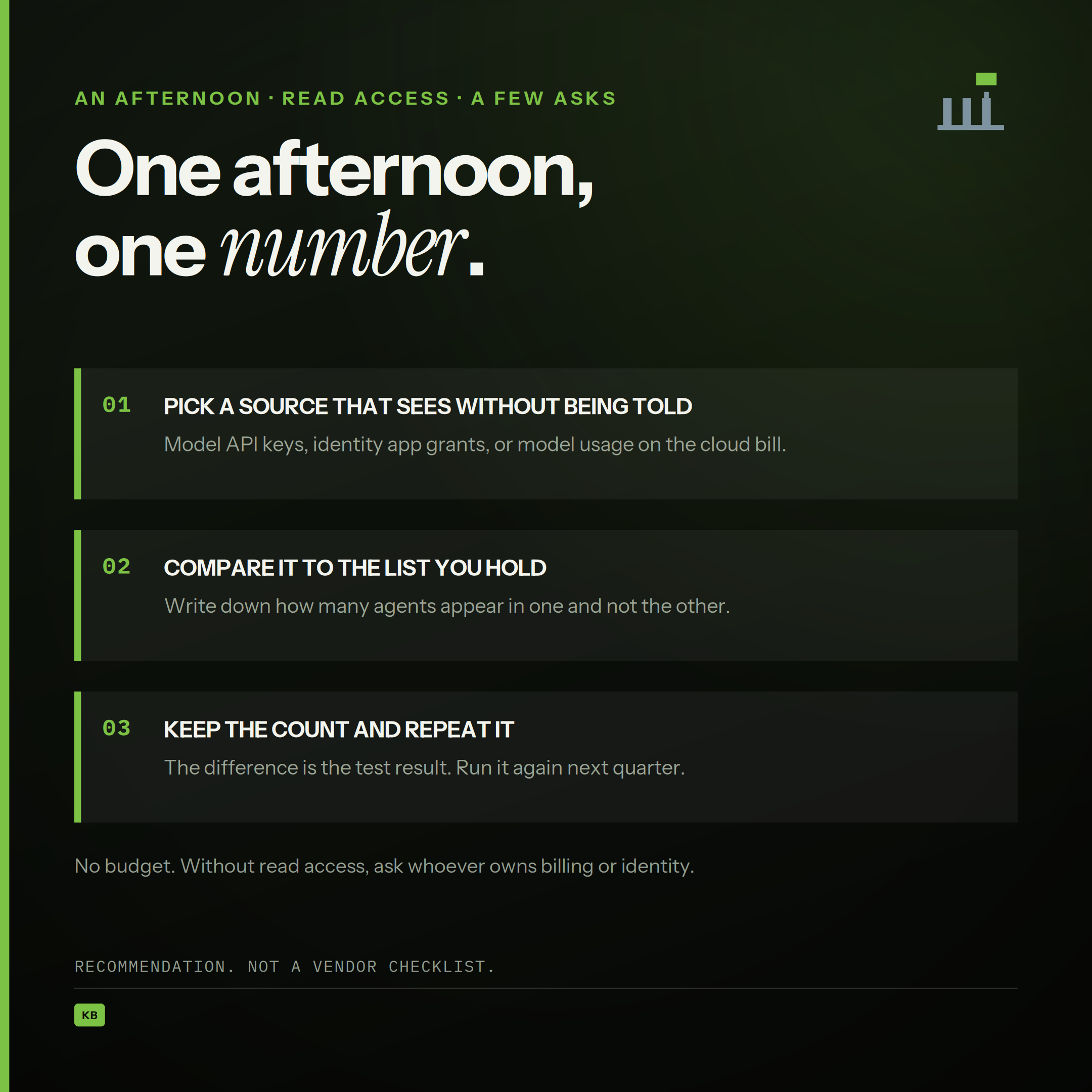
That number is your test result, and it is worth repeating next quarter. Expect it to take an afternoon if you already have read access to those consoles. If you do not, you will need whoever owns billing or identity, and that conversation is often the harder part.
This is the wrong exercise for a team of a few people with a handful of agents, where asking around is a real test. It also does not replace a required register in regulated settings, where the register is itself the control. The claim is only that registration alone cannot show completeness.
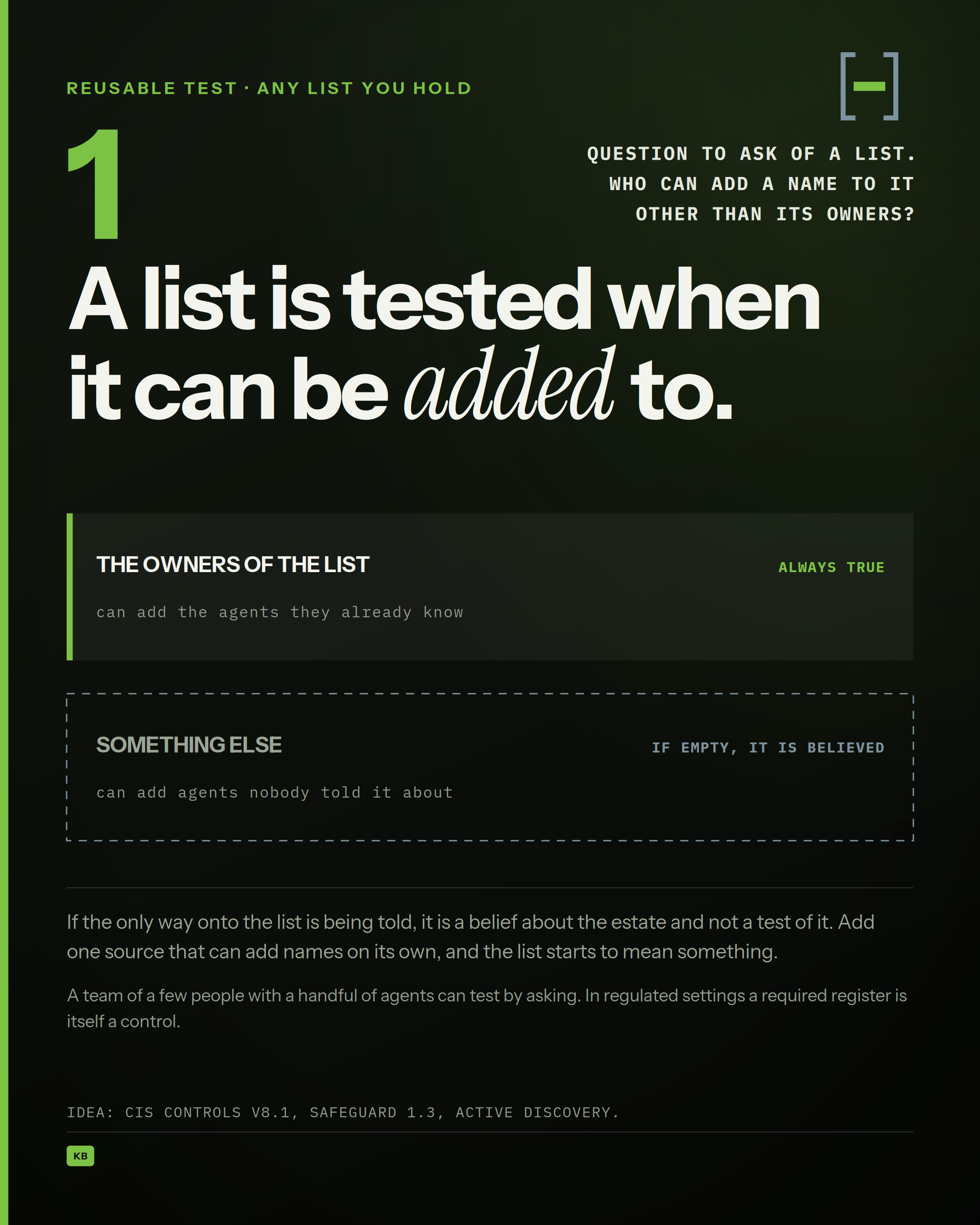
A list is tested only when something other than its owners can add a name to it, and a register that waits to be told can never show that it is complete.
Has your agent list ever surprised you?
Where these numbers come from
Guild.ai, "The AI Agent Management Gap Is Growing", press release 22 September 2026, and the AI Agent Management Gap Report page. Fielded 4 to 9 August 2026 by Morning Consult among 362 US IT decision makers at organisations with 100 or more employees. The release states a margin of error of plus or minus 5 points.
Harness, "New Harness Report Reveals Enterprise Confidence in AI Agents Isn't Backed by Real Controls", 10 September 2026. 700 technology professionals at large enterprises in the US, UK, France, Germany and India, fielded by Sapio Research in July 2026.
Cloud Security Alliance, survey commissioned by Token Security, press release 21 April 2026. 418 responses, fielded January 2026.
CIS Critical Security Controls v8.1, Control 1, Safeguard 1.3, Utilize an Active Discovery Tool.
Guild and Harness sell products in this area. Token Security commissioned the third survey. All three are vendor-linked surveys of self-reported answers.
The Execution Edge
A monthly deep dive on enterprise AI and turning strategy into execution, written from inside the programme office rather than above it.