
Field Essay
Wipro freed capacity worth 20,000 people. Its own datasheet says where it went
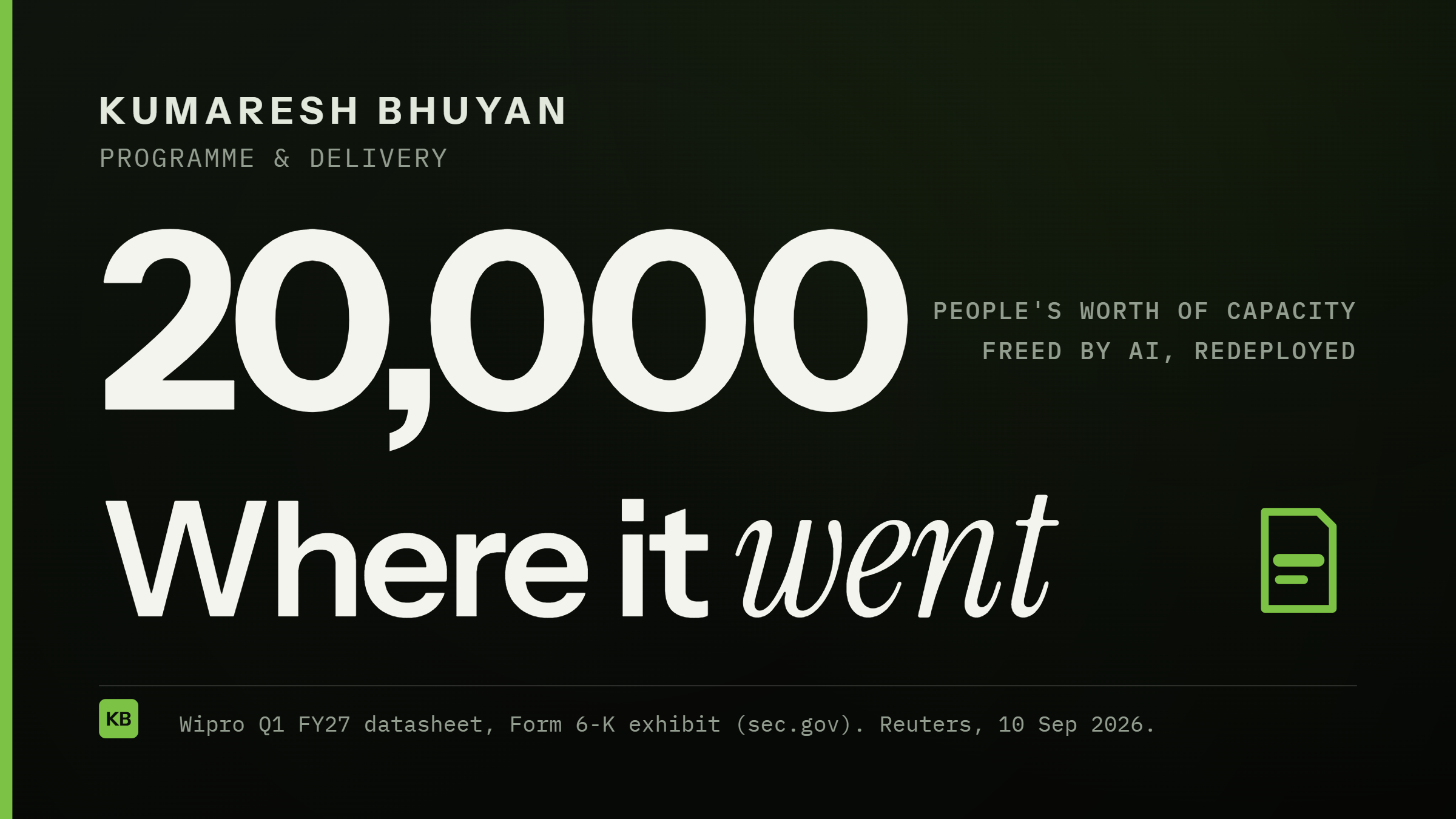
Wipro's CTO said AI has freed productivity equivalent to 20,000 employees. Its own Q1 FY27 datasheet puts net utilisation at 83.6 percent against 85.0 a year earlier. Freed capacity is not a saving. It is a position, and somebody is carrying it.
· 6 min read · Kumaresh Bhuyan
I have held freed capacity on purpose before, against work I expected to win. It is a bet, not an accident, and somebody carries it while everyone waits to see whether it pays.
On Thursday, Wipro's chief technology officer told Reuters that the company's AI work has freed productivity equivalent to the output of 20,000 employees, who have since been redeployed inside the firm.
Freed capacity is not a saving. It is a position, and somebody is carrying it.
TWO STATEMENTS, EIGHT WEEKS APART
Wipro's Q1 FY27 datasheet, filed with the SEC as an exhibit to its Form 6-K for the quarter ended 30 June 2026, carries the number that measures exactly that. Net utilisation excluding trainees is the share of available delivery capacity actually billed.
It reads 83.6 percent. A year earlier it was 85.0 percent.
Over the same twelve months headcount went from 233,232 to 243,044, IT services revenue rose 1.0 percent to 2,614.5 million dollars, and operating margin went from 17.3 percent to 16.0 percent. Guidance for the September quarter is minus 1.5 to plus 0.5 percent sequentially.
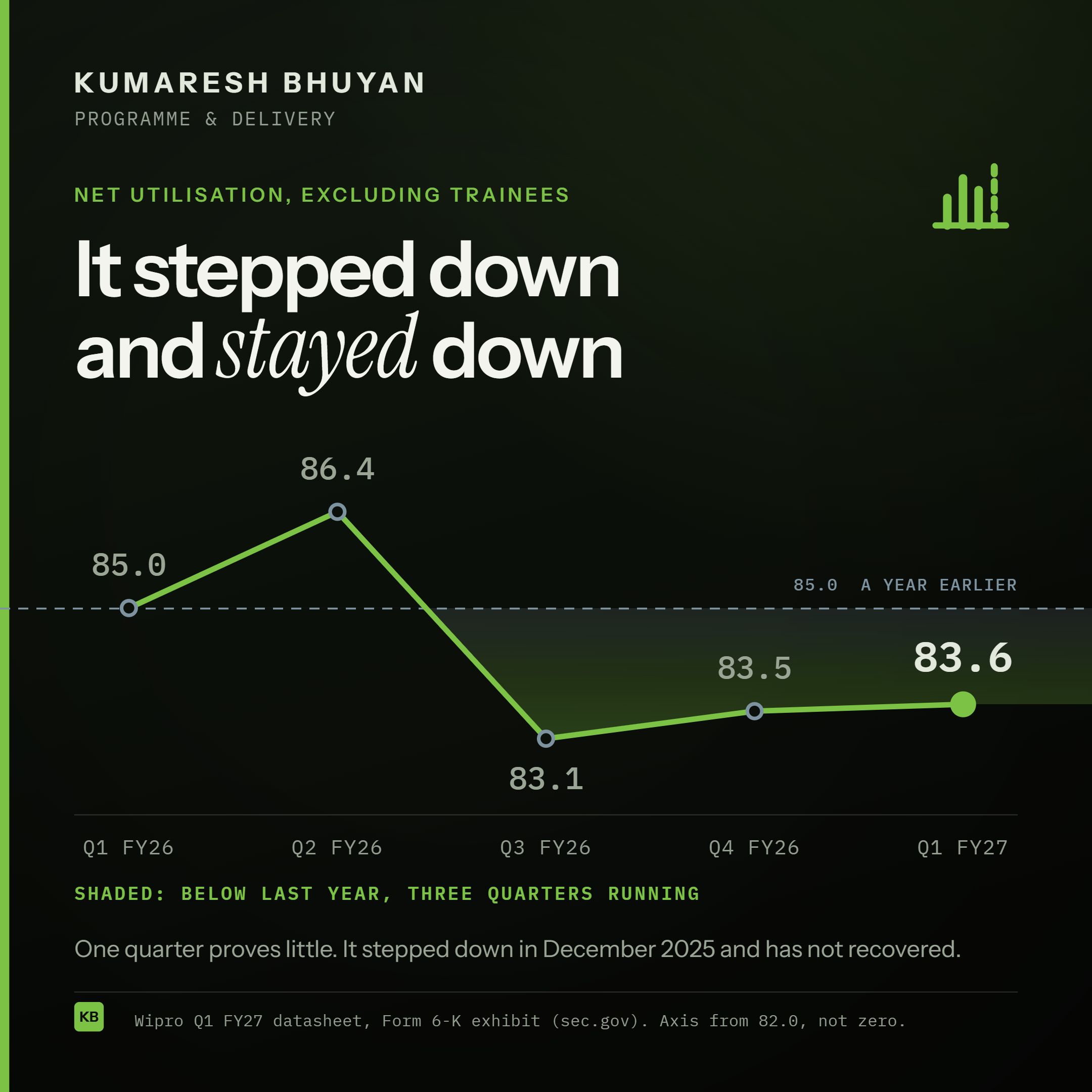
More people, a smaller share of them billed, flat revenue, thinner margin.
None of that is a gotcha. Wipro had already explained it. On the July results call, chief financial officer Aparna Iyer said: "If you look at utilization year on year, we have decreased our utilization to invest in some of the deals that we're looking at. That will also go up through the year. That will also be a lever."
So Wipro told you where the 20,000 went, eight weeks before the number that travelled. Into a position, held deliberately, against deals that have not closed.
A GAIN VERSUS A POSITION
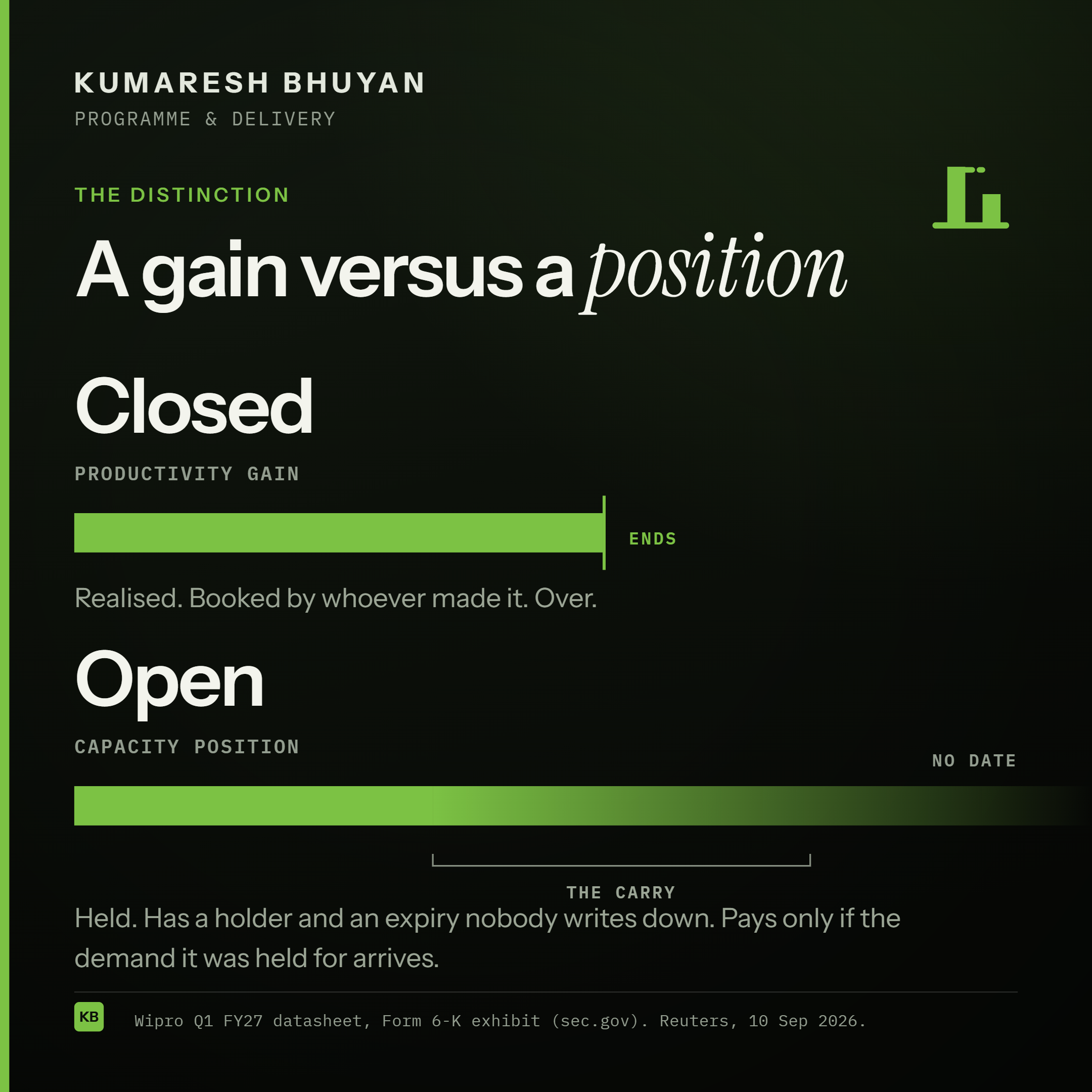
A productivity gain is realised. A capacity position is held.
A gain is booked by whoever made it and then it is over. A position has a carry, a holder, and an expiry nobody writes down. It pays out only if the demand it was held for arrives, and if it does not, it gets closed at a loss by whoever is standing nearest.
WHO CARRIES IT
This next step is argued rather than evidenced.
The gain gets reported upward in whatever unit is cheapest to produce. Wipro used headcount-equivalents. My own programmes report hours saved. Both are input measures and both are produced by the people who made the gain.
The position lands somewhere else. Unbilled hours, bench, people held ready: those sit on a delivery number, not on a pipeline. The upside belongs to whoever closes the deal. The carry belongs to whoever runs the programme while everyone waits.
THE STRONGEST CASE AGAINST THIS
Freed capacity pointed at platform work and reusable assets is not idle. It is investment, and investment shows up late by definition. That is the productivity J-curve, Brynjolfsson, Rock and Syverson's formalisation of Solow's complaint about seeing the computer age everywhere except in the productivity statistics. The measured dip comes first.
Manoj Chandra Jha of Nord-IQ Research made the same point at Wipro directly, telling Reuters the firm is in the earlier, cost-absorbing phase and that the real test comes when deals convert to revenue and margin recovery.
He is right, and the test has a date. Wipro reports the September quarter in October, and Iyer has already said utilisation "will also go up through the year". That is falsifiable, which is more than most AI productivity claims manage.
WHERE THIS STOPS
One quarter against one quarter proves little. Utilisation ran 85.0, 86.4, 83.1, 83.5 and 83.6 across five quarters, so it stepped down in the December 2025 quarter and has sat around 83.5 in the three quarters since. The honest reading is that it has not recovered, not that it is falling.
And the two numbers do not share a population. The 20,000-equivalent figure carries no published scope or period; utilisation is defined in the filing as IT services excluding BPS and entities not integrated into Wipro's systems. I have not divided one by the other and nobody else should.
Reuters also notes that Wipro is the only firm in India's top four that does not disclose AI revenue. The one number that would settle this is the one not published. That is a finding, not a gap.
WHAT TO DO WITH IT THIS WEEK
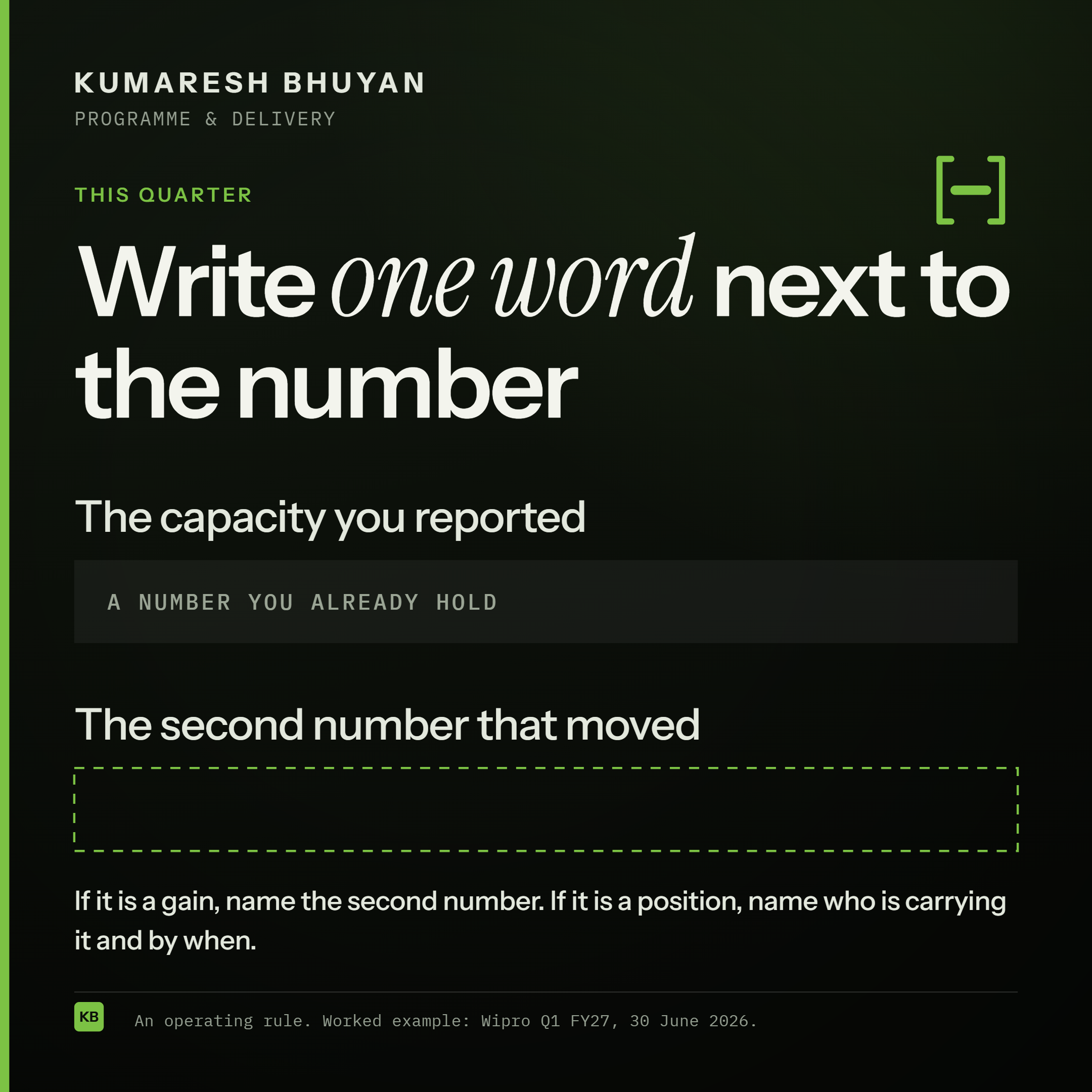
Take the AI capacity number your programme is reporting this quarter. Write next to it which of the two it is.
If it is a gain, name the second number that moved. If it is a position, name who is carrying it and the date by which the demand has to arrive.
Wipro's CTO said the shift has to be from productivity to outcomes. She is right, and the reason it is hard is arithmetic rather than intent. The productivity number is cheap to produce. The outcome number is not.
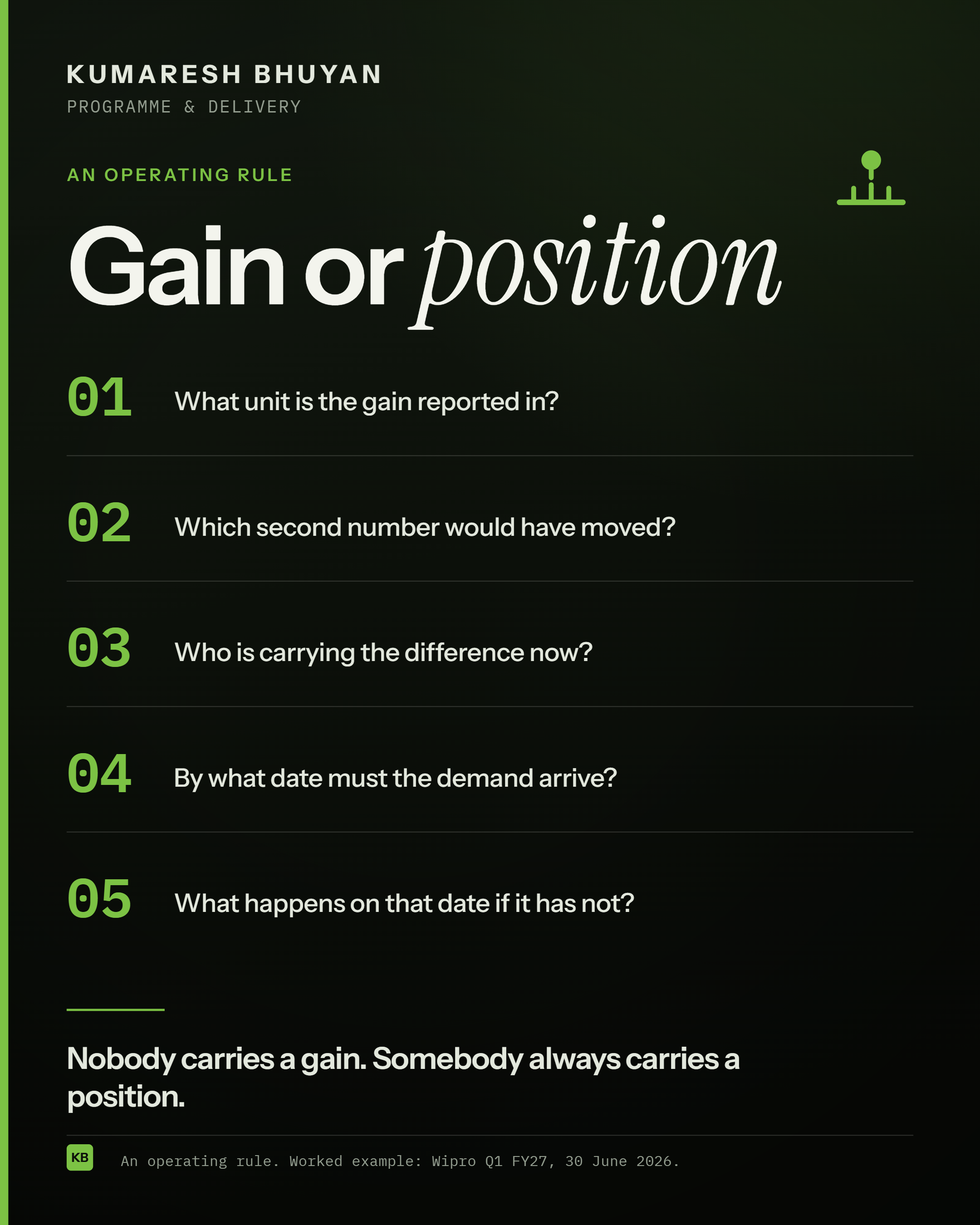
Nobody carries a gain. Somebody always carries a position.
On your programme this quarter: gain, or position?
WHERE THESE NUMBERS COME FROM
Wipro Limited, Q1 FY27 datasheet, exhibit to Form 6-K, quarter ended 30 June 2026, filed with the US Securities and Exchange Commission. Net utilisation excluding trainees 83.6 percent, against 85.0, 86.4, 83.1 and 83.5 for the four preceding quarters. Closing employee count 243,044, against 233,232 a year earlier. IT services revenue 2,614.5 million dollars, up 1.0 percent year on year and 0.9 percent in constant currency. IT services operating margin 16.0 percent, against 17.3 percent a year earlier. September-quarter guidance 2,574 to 2,627 million dollars, minus 1.5 to plus 0.5 percent sequentially in constant currency. Note 6 of that datasheet defines utilisation as IT services excluding BPS and entities not integrated into Wipro's systems at the start of the fiscal year.
Reuters, 10 September 2026, Sai Ishwarbharath B and Abhirami G, Bengaluru. CTO Sandhya Arun on productivity equivalent to 20,000 employees, redeployment, more than 100,000 employees in advanced AI training, "the shift has to be from productivity to outcomes", and the observation that Wipro is the only firm in India's top four that does not disclose AI revenue. Analyst comment from Manoj Chandra Jha, principal analyst, Nord-IQ Research.
Wipro Q1 FY27 results call, 17 July 2026. CFO Aparna Iyer on utilisation as a deliberate investment and as a margin lever.
Erik Brynjolfsson, Daniel Rock and Chad Syverson, "The Productivity J-Curve: How Intangibles Complement General Purpose Technologies", American Economic Journal: Macroeconomics, 2021. Robert Solow's original remark appeared in the New York Times Book Review in July 1987.
The Execution Edge
A monthly deep dive on enterprise AI and turning strategy into execution, written from inside the programme office rather than above it.