
Operating Rule
The Symmetric Value-Gate Rule
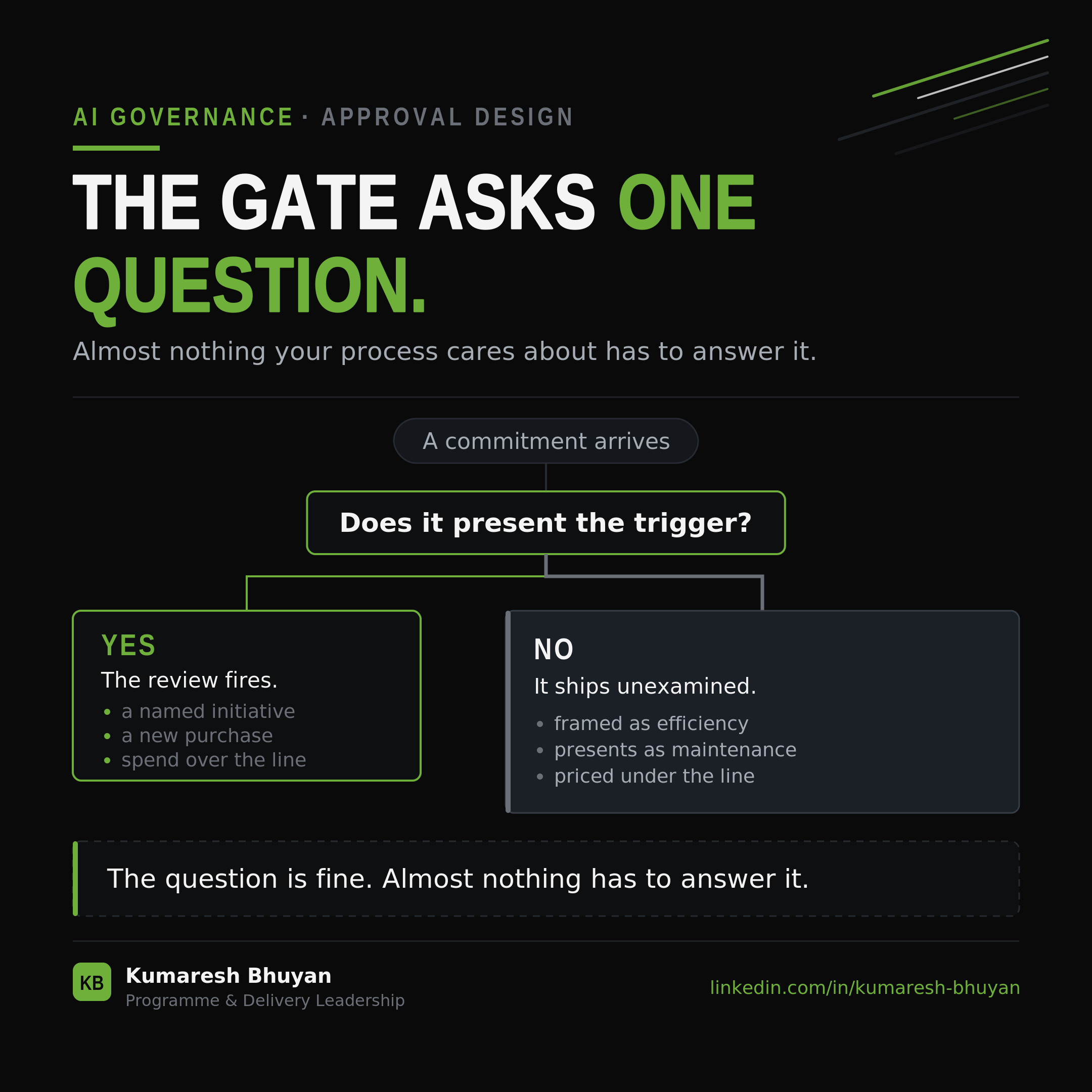
Your process asks one question, and it is not what a thing costs or commits you to. It asks whether the thing presents the trigger, and almost nothing consequential has to answer that. So audit what makes your gates fire, not what they were written to cover.
· 3 min read · Kumaresh Bhuyan
This is the fifth time I have written about approval gates, and the first time I can say what the other four were circling. Your process asks one question, and it is not what a thing costs or commits you to. It asks whether the thing presents the trigger, and almost nothing consequential has to answer that. So audit what makes your gates fire, not what they were written to cover.
Why it holds
Somebody once wrote down what counts as an initiative, what counts as a purchase, and what size of number needs a business case. Those definitions have not moved. The commitments they were built to catch have moved a long way. Where the two stop overlapping the gate does not fail, it never runs, and a control that never runs leaves the same evidence as one that approved everything.
Three cases from the last six weeks, each escaping by a different route.
Framing. Through July the same buyers cancelling pilots for lacking a named owner were still committing to platform and silicon bets on a promise of efficiency. An efficiency promise does not describe itself as an initiative, so nothing asked it for a number it had to move.
Category. Databricks reported on 7 August that Stripe evaluated Opus 4.7, found no meaningful quality gain over 4.6 at higher cost, and declined to make it available internally. Databricks measured the same regression from Opus 4.8 to 5.0, and found that routing each request to the cheapest capable model cut average task cost by more than 30 percent at matching quality. Stripe caught that only because it ran an evaluation. An upgrade presents as maintenance, and maintenance does not get a business case.
Price. McKinsey's State of AI of 25 August found 32 percent of 1,719 respondents had declined to buy at least one software product or feature because they could build it in-house with coding agents, rising to nearly half among high performers against 31 percent of everyone else. That build clears every threshold that would have routed the equivalent purchase to procurement. Nothing was bypassed, because nothing fired.
Where it stops
Read literally this rule is bad advice, and the limit is worth more than the rule. Gates decay as volume rises. In Anthropic's published permission data people approve 97 percent of individual prompts while rejecting 39 percent of plans, and across 1,053 paid testers auto mode blocked 800 commands a human had approved while humans blocked 6 that auto mode allowed. So adding a review step to a high-frequency process can make it less safe while making it look safer. Move the trigger. Do not multiply the gates.
The deliberate version of this is also old and already named. Public procurement calls it contract splitting, prohibits it, and applies a piecemeal rule treating a divided requirement as one whole. The difference worth keeping is intent. Contract splitting is somebody dodging a threshold on purpose, so there is a person to catch. These three walked under a threshold with nobody trying, which is why nobody is looking.
What to do with it
List the largest commitments your organisation made in the last twelve months and name the specific thing that caused each approval to be requested. A number crossing a line, a form carrying a project name, a procurement request. Where you cannot name one, that commitment did not pass a gate. It avoided one.
The question your gates ask is a good one. Almost nothing that matters has to answer it.
What did your organisation commit to this year that would have gone to review if it had been priced differently or called something else?
Sources: Databricks, Managing AI Coding Costs at Scale, 7 Aug 2026. McKinsey, The State of AI in 2026, 25 Aug 2026. Anthropic, Claude Code auto mode engineering post, Aug 2026. Stockholm School of Economics working paper on contract splitting in public procurement.
The Execution Edge
A monthly deep dive on enterprise AI and turning strategy into execution, written from inside the programme office rather than above it.